
Preparing for Rising Food Costs: A Calmer Plan for Your Household
Just a heads up, this post contains some affiliate links. That means that we earn a small commission if you buy the product at no extra cost to you. That allows us to continue to research and share interesting articles with you. :)
An expensive food shop has a way of following you home. You’ve put everything away, but you’re still thinking about the total on the receipt and wondering how much higher it might be next time.
I understand the temptation to buy extra while you can. Having food put aside feels reassuring. But reassurance gets rather expensive if it means buying things you won’t eat, filling space you don’t have, or leaving yourself short for the rest of the week.
For me, preparing for rising food costs starts with making our ordinary shopping work a little better. That means knowing what’s available at home, keeping ingredients for meals we enjoy, and adding a modest amount of extra food when we can comfortably afford it.
There’s plenty you can do before you spend another penny. And when buying ahead does make sense, you can give it a clear purpose and a sensible limit.
I talk about how this fits into our own home in How I’m Preparing for Rising Costs — Without Panic Buying. If you haven’t seen the video, come and join me for the longer conversation: I share examples from our pantry and explain why I’ve also been thinking about power cuts and the practicalities of staying away from home temporarily. Here, we’ll turn the food-shopping side into a plan you can use for your own household.
First, decide what you want a food reserve to help with
“Be more prepared” is a difficult instruction to act on. Prepared for what, and how will you know when you’ve done enough?
A smaller, more specific aim is easier to work with. Perhaps you’d like enough ingredients to manage a few dinners if shopping has to wait. Perhaps you want quick meals for the days when cooking feels like too much. Or perhaps you’d like to replace your most-used foods before you completely run out.
Those are useful reasons to keep a little extra. They also give you a way to judge what belongs on the shelf.
In our house, flour earns its space because I bake regularly. Someone who rarely bakes might get much more use from a few tins of soup. Neither cupboard is better simply because one looks more impressive.
Try finishing this sentence: “It would make our week easier if we could…”
Your answer can guide what you do next. The free Household Breathing Room Workbook gives you space for checklists, useful information and household plans. Use whichever part helps with the problem you’ve chosen; the rest can wait.
Find the meals hiding in your kitchen
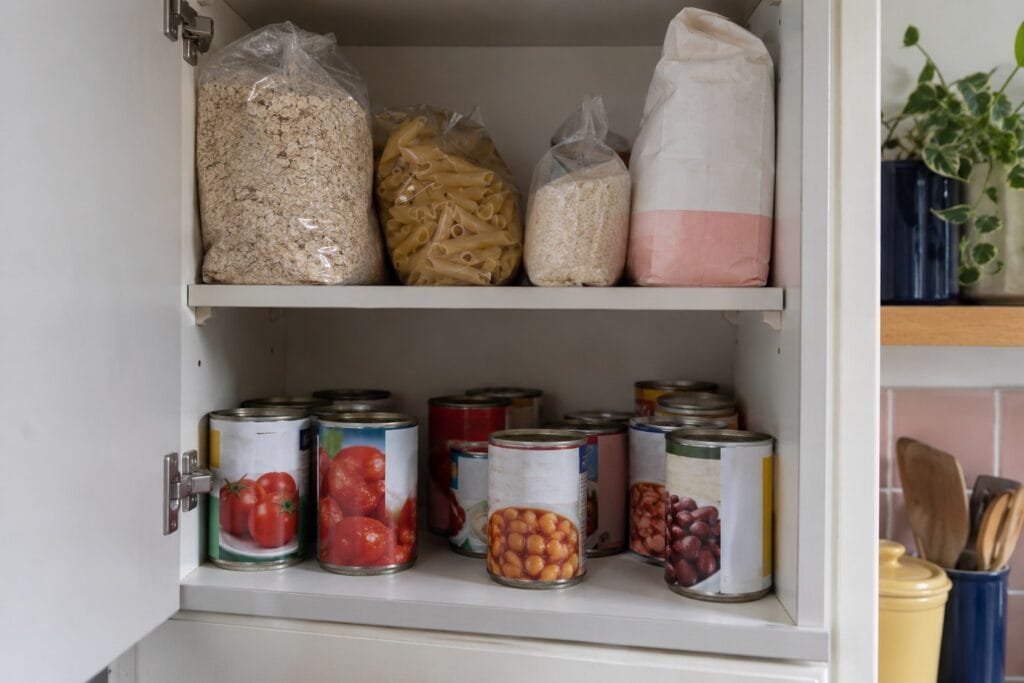
Before drawing up a longer shopping list, take a short look through the cupboards, fridge and freezer. You’re looking for possible meals, things that need using, and the staples you reach for repeatedly.
You don’t need to catalogue every peppercorn. Start with one area and ask:
- What could we make with this food?
- What small addition would turn it into a meal?
- What needs attention before we forget about it again?
Sometimes the missing item is much smaller than the shop you were about to do. You may already have pasta and tomatoes, for example, and only need something to finish the sauce.
This is also a chance to notice your accidental collections. Ours includes an unreasonable number of partly used gravy containers. Seeing those together tells me rather more about what we need than another trip down the supermarket aisle would.
Keep food you intend to use soon somewhere easy to see, while following its storage instructions. Make a note of the meals it could become. Otherwise, it’s very easy to do a cupboard check, feel briefly organised, and then forget the useful bit by dinner.
If space is making this awkward, our small-kitchen pantry declutter video looks at making existing storage work better. Being able to find your food is a good starting point, however small the kitchen.
Build a reserve that belongs in your normal shopping
The approach I call stocking forward is simply getting a little ahead with foods you already use. You carry on eating them and replenish them through your usual shopping.
It’s easier to maintain because you don’t have two separate collections: everyday food and a mysterious emergency supply nobody quite knows what to do with.
Imagine you regularly make a tomato-based pasta sauce. When your budget allows, you could buy one additional tin of tomatoes. Keep the older tins where you’ll use them first, and put tomatoes back on the shopping list while you still have some left.
You might eventually decide that a couple of spare tins suits your household. Once you reach that amount, you can stop adding to it and simply replace what you use. There’s no need for the reserve to grow every time you go shopping.
Choose the amount according to your household’s habits, your space and your available money. A quantity that lasts one family a week might take another several months to finish.
And give yourself permission to use it. If shopping has to wait because another bill takes priority, the food you set aside can help with dinner. Afterwards, rebuild gradually when you’re able. A reserve is useful because it can be drawn on, not because it stays untouched.
Choose a few dinners, including one for a tired evening
A shelf of ingredients becomes much more reassuring when you can picture what you’ll cook with them.
Write down three meals your household already enjoys. Check which ingredients you can keep available, which need refrigeration, and which you’d usually buy fresh.
Here are some starting points to adapt:
| Meal | Ingredients to consider | Check before buying extra |
|---|---|---|
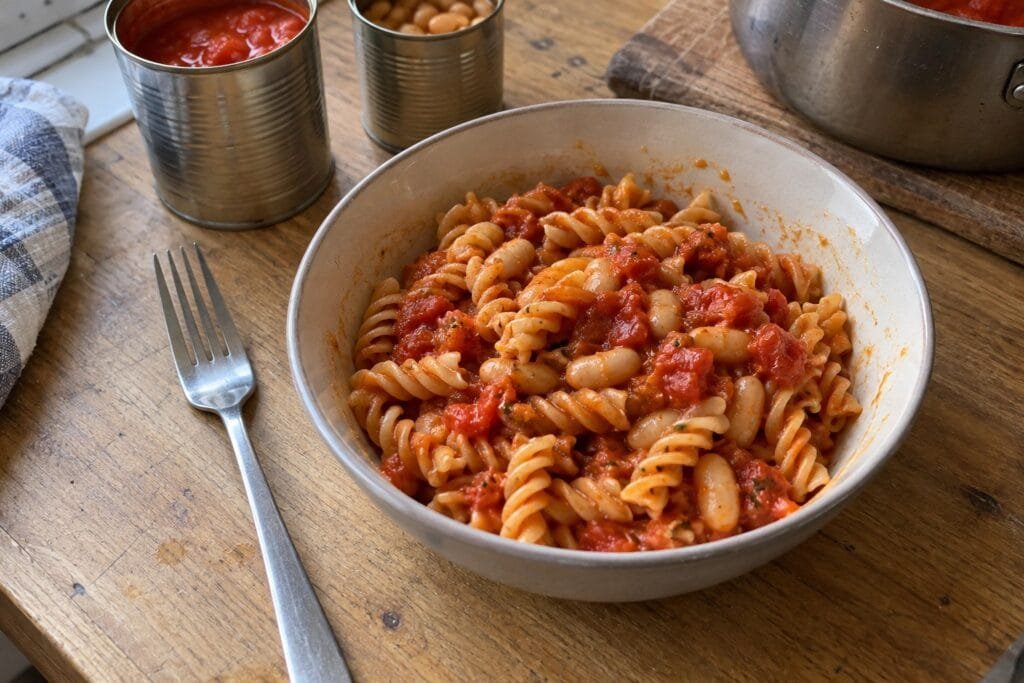
| Tomato and bean pasta | Pasta, tinned tomatoes, beans and familiar seasonings | Will everyone eat it, and are all the ingredients there? |
| A simple lentil curry | Lentils, rice and your usual sauce or spices | Does it fit your cooking time and household preferences? |
| Soup with bread | A soup you like and a suitable bread option | Where will the bread be stored, and does the meal need heating? |
These are examples rather than a recommended shopping list. Choose your own familiar combinations, taking account of allergies and dietary needs.
Include something easy. I enjoy cooking and preserving, but I don’t want the usefulness of our pantry to depend on me having a productive afternoon. Some evenings, getting a decent meal ready with very little work is enough.
It’s also worth distinguishing an easy hot meal from food you can eat without cooking. If a power cut affects your hob, they become quite different options. Keep some suitable ready-to-eat cupboard foods if you can, along with a tin opener where needed.
Give every offer four checks
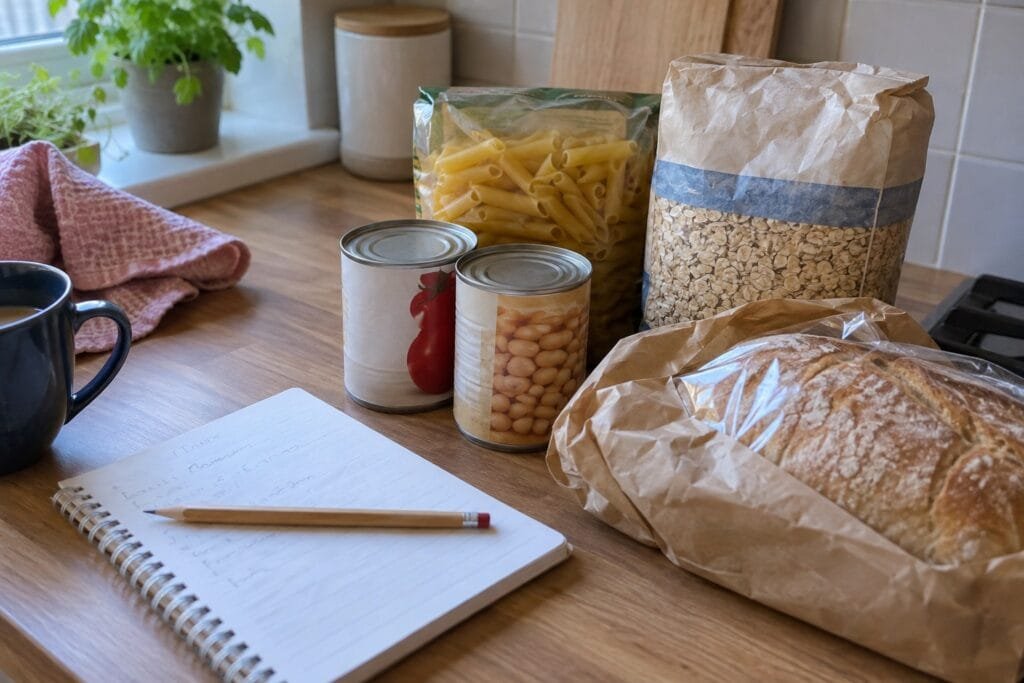
An offer deserves a moment’s thought, especially when worrying news makes buying more feel urgent.
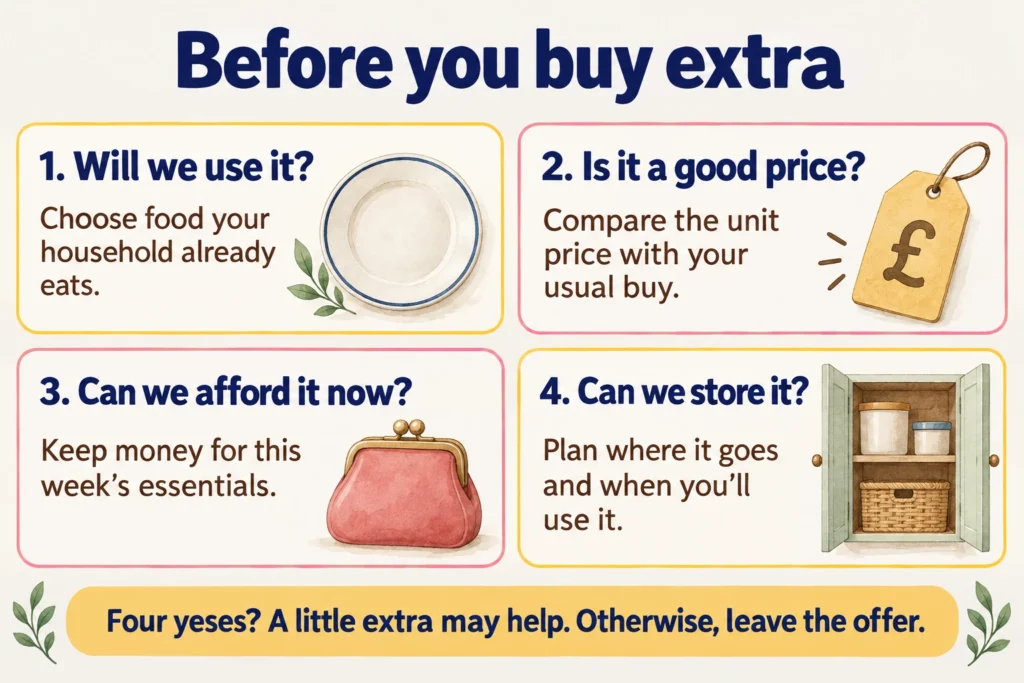
Before putting an extra item in the basket, check four things:
- Use: Is this something we eat regularly?
- Price: How does it compare with what we normally pay?
- Budget: Can we pay for it without squeezing something essential?
- Storage: Have we got suitable space and a realistic plan to use it?
An offer that passes all four may be worthwhile. One that only passes the price check can still leave you with wasted food or an uncomfortable week financially.

Use these four checks to decide whether an extra purchase will help your household.
Look beyond the promotion sticker
Compare prices using the same unit, such as cost per kilo or litre. Different pack sizes can make a discount look more generous than it is, and your usual own-brand option might still cost less.
For a manageable starting point, note the normal prices of five foods you buy often. You’ll have a useful comparison when a promotion appears, without turning every shopping trip into a research project.
Remember to consider the total you’ll spend today as well as the unit price. A large pack might be cheaper by weight and still be more money than you can spare.
Let your current budget set the pace
Buying ahead should leave you better placed to manage the household. If it creates a shortfall now, it isn’t helping with that aim.
On a tight week, concentrate on what you already have. Planning meals, reducing duplicate purchases and using food in time can all be useful. You can return to the extra purchases later, if circumstances allow.
There’s no timetable to catch up with here. Someone else’s full pantry doesn’t tell you what your household should spend.
Check where the food will live
Decide on storage before buying the extra food. This is considerably easier than arriving home with bags of shopping and discovering that the only remaining cupboard space is occupied by a cake tin you use once a year.
Follow the product’s storage instructions, including any changes after opening. Choose a suitable place where you can reach the food and check it regularly. Put older supplies where you’re likely to use them first.
For freezer purchases, check the available space and whether the product is suitable for freezing. Label food clearly so you can identify it later.
The Food Standards Agency’s chilling, freezing and defrosting guidance recommends following product instructions and defrosting in the fridge. It also explains that freezing does not kill all bacteria. Proper handling still matters before and after food goes into the freezer.
You don’t need a dedicated pantry room. What you need is an amount you can store safely and manage easily. Buying less can be the sensible choice if your available space is limited.
Fit growing and preserving around your life
Our food comes from a mixture of growing, preserving and shopping. That combination lets us use what we can produce without expecting the garden to supply everything.
I preserve some of our homegrown tomatoes and buy others. Some of our jam has been made with supermarket fruit bought cheaply. Those choices reflect what was available and what I could make use of at the time.
If you have extra produce, choose a plan that fits your time, equipment and storage. A discount is less useful if dealing with it becomes another task you can’t realistically manage.
The free Save the Glut Decision Chart can help you consider different ways to use or preserve produce. Treat it as a planning aid, and use appropriate food-safety guidance and tested recipes for your chosen method.
Making something yourself can be satisfying. Buying it ready-made can be practical. You’re allowed to decide which works best for this particular week.

The free workbook gives you a place to record the small steps that suit your home.
Make your first step small enough to finish
You could begin with ten minutes and one cupboard. Find the ingredients for a meal, identify a gap, and write it down. Or choose one regularly used food you might keep a little ahead of, once there’s room in the budget.
That gives you something concrete to build on. Over time, you can learn what quantities suit you, which meals are useful when you’re tired, and which purchases genuinely earn their space.
If you’d like a place to keep your notes, download the free Household Breathing Room Workbook. Start with the part that would help you most this week.
And if you haven’t watched it yet, join me in the video: How I’m Preparing for Rising Costs — Without Panic Buying. Alongside the pantry examples, we talk about some of the wider household preparations that have been on my mind, from having a working light during a power cut to thinking about what we and the dog would need away from home.
The UK Government’s household preparedness guidance is also a useful reference for those wider plans. It includes practical steps that cost nothing, as well as supplies you can build up gradually.
You don’t have to resolve every uncertainty to make a useful decision today. Knowing what’s in the kitchen and how you could feed everyone for a few meals is a very reasonable place to begin.
What would make the biggest difference in your home: easier dinners, clearer cupboards, or a little more flexibility between shopping trips? I’d love to hear where you’d start.
Back To The Good Life is a participant in the Amazon Services LLC Associates Program, an affiliate advertising program designed to provide a means for sites to earn advertising fees by advertising and linking to Amazon.com. We also participate in other affiliate programs which compensate us for referring traffic.
