
Just a heads up, this post contains some affiliate links. That means that we earn a small commission if you buy the product at no extra cost to you. That allows us to continue to research and share interesting articles with you. :)
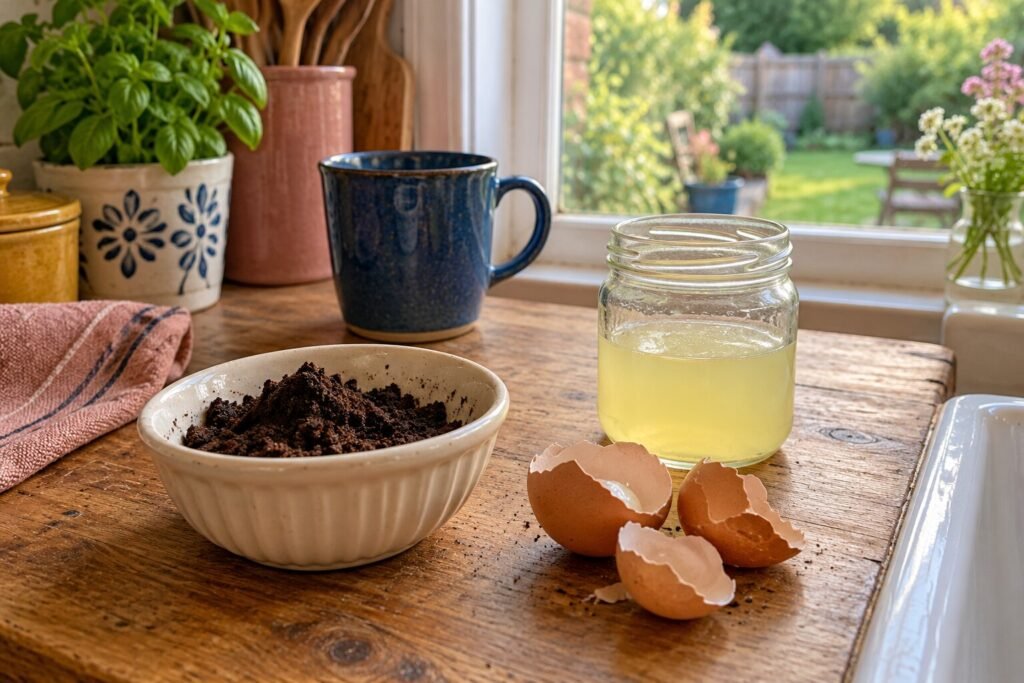
There is a point at which saving things for the garden starts to look suspiciously like refusing to empty the kitchen. A few eggshells drying on the windowsill. Coffee grounds waiting by the sink. A jar of whey that needs a purpose.
I recognise that point. I have been experimenting with all three.
The most useful way to reuse kitchen scraps in the garden is usually to compost them first. Used coffee grounds and loose tea leaves can go into a mixed compost heap, while crushed eggshells break down slowly. Whey needs more caution: it is an experiment, not a dependable all-purpose plant feed.
That distinction matters when you are trying to save money. A free ingredient is only helpful if it does a useful job. Here is what I have tried in our ordinary UK garden, what the evidence supports, and how to keep the whole thing manageable.
Watch my kitchen scraps in the garden video to see the whey, eggshell preparation and tea-and-coffee habits behind this article. The guide below adds some important qualifications to the experiments I describe on camera.
Which kitchen scraps can you use in the garden?
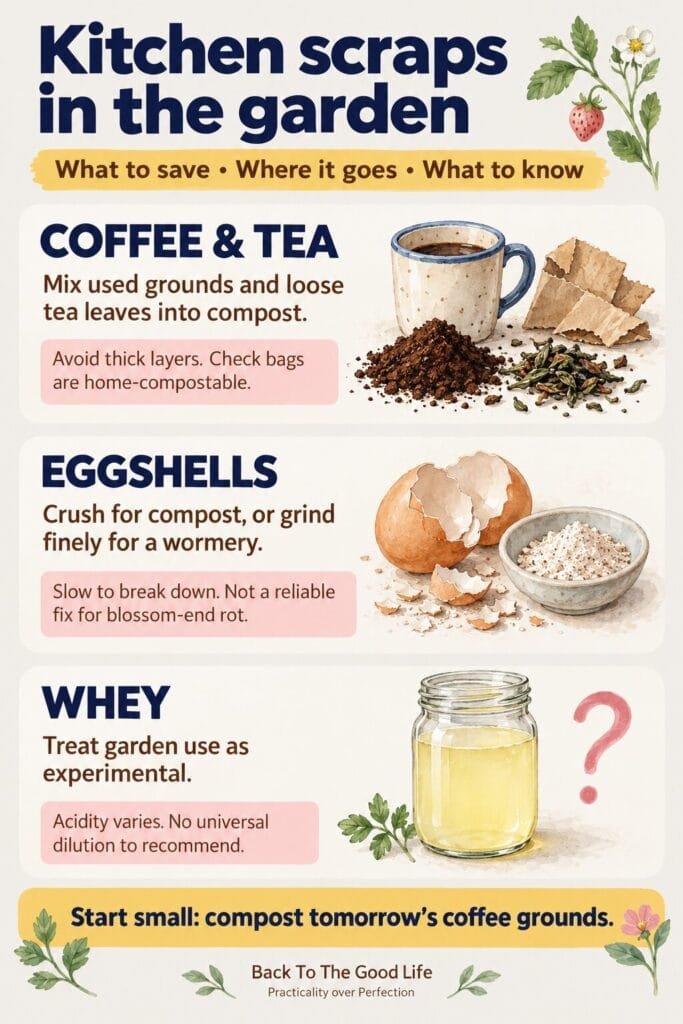
Start by deciding where a scrap belongs. “Contains nutrients” does not automatically mean “pour it around a plant”. This is the quick version for the three groups I cover in the video.
| Kitchen scrap | Useful starting point | Main limitation |
|---|---|---|
| Used coffee grounds and tea leaves | Add to mixed compost; use suitable amounts in an established wormery. | Avoid thick layers of grounds and check whether tea bags are home-compostable. |
| Eggshells | Crush for compost, or finely grind for a wormery. | Slow breakdown; not a reliable treatment for blossom-end rot. |
| Whey from yoghurt or cheese | Treat garden use as experimental rather than a beginner recommendation. | Variable acidity and composition; no universal home-garden dilution to recommend. |
1. Coffee grounds and tea leaves: start with the compost
Coffee and tea are thoroughly established parts of my household routine. Finding a use for what is left afterwards appeals to me considerably more than creating an entirely new gardening chore.
I have tried putting used coffee grounds directly on the soil, including making the mistake of leaving a soggy layer on top. It can become compacted, which rather defeats the point when you want water to reach the roots.
Are coffee grounds good for plants?
Used coffee grounds can contribute organic matter and nutrients, but they are not an instant, balanced fertiliser. The RHS guide to coffee grounds explains that residual caffeine can suppress plant growth and that the effects depend on the amount, plant and conditions.
For a straightforward home routine, composting is the option I would point you towards first. Mix the grounds with other material rather than letting them build up in one dense patch.
In the video, I mention mixing grounds into compost for seedlings. This is a detail worth qualifying: I would leave uncomposted grounds out of seed-sowing mixes. There is little reason to add an uncertain ingredient at the stage when you are trying to get seeds established.
Nor would I use coffee grounds as a precise way to make soil acidic. The University of Minnesota’s advice on garden home remedies explains why that common claim is unreliable. A plant needing particular soil conditions deserves a more dependable approach than whatever happens to be left in the filter.
How to compost used coffee grounds
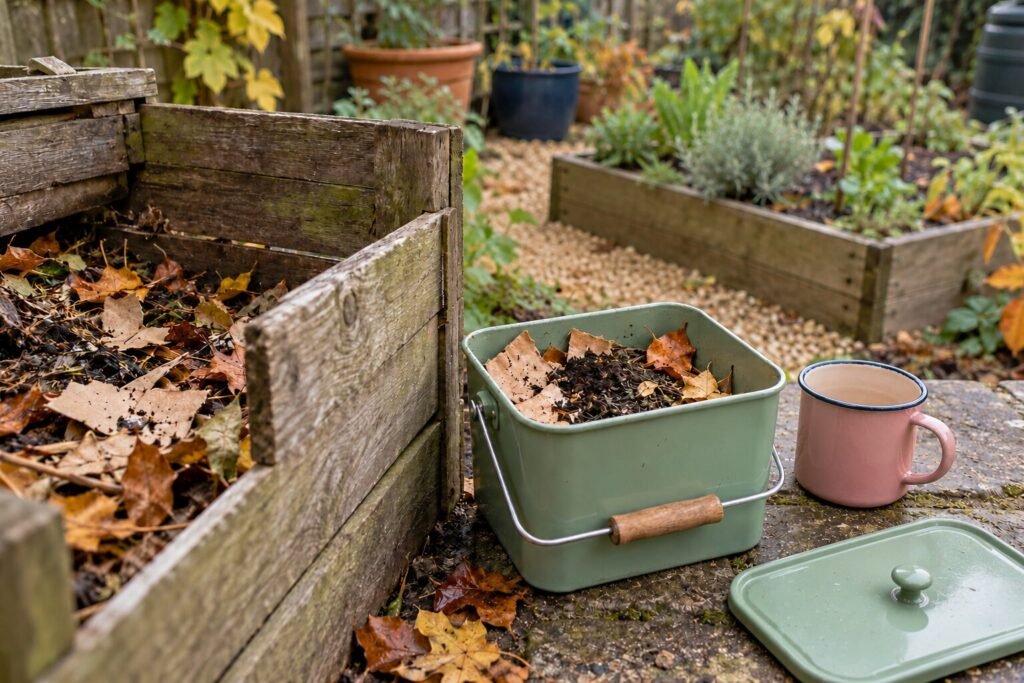
- Let the grounds cool after brewing.
- Empty them into your compost with other suitable scraps.
- Mix in dry material, such as torn plain cardboard or dry leaves, rather than adding coffee in a solid layer.
- Keep an eye on the whole mixture. If it is becoming a wet, dense mass, add dry material and improve the airflow.
Coffee grounds count as a nitrogen-rich “green” in composting, despite being brown. Gardening terminology does occasionally enjoy making life unnecessarily confusing. University of Maryland Extension’s composting guide lists both coffee grounds and tea leaves among these nitrogen sources.
Can tea bags go in home compost?
The tea leaves can; the bag depends on what it is made from and how it is certified. “Plant-based” and “compostable” do not necessarily mean a bag will break down in your home compost heap.
For example, Taylors’ information about plant-based tea bags describes industrial composting through council collections. That is different from a cool bin at the bottom of the garden. Check your current packet and your council’s accepted materials.
If you are unsure, open the used bag, compost the leaves and dispose of the empty bag according to its instructions. It is a small extra step, but it saves fishing mysterious little bags out of finished compost later.
2. Eggshells: worth saving, with realistic expectations
I used to break eggshells up by hand and scatter the pieces around my plants. It felt productive. The pieces then sat there, looking remarkably similar to when I had put them down.
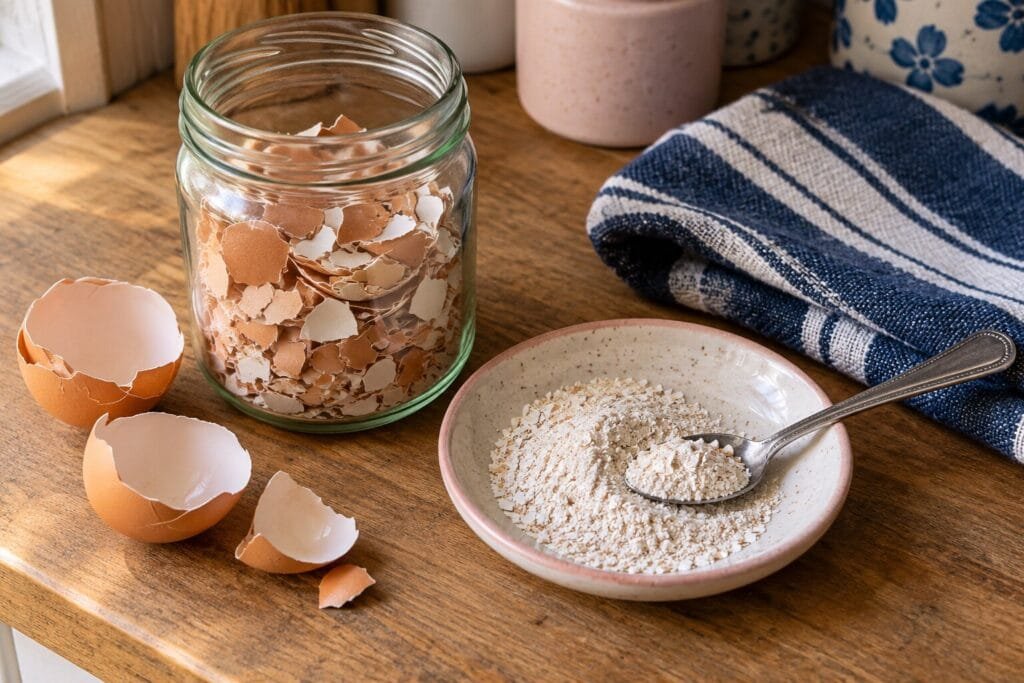
In the video, I show the change I made: drying the shells, collecting them in a jar and grinding them much more finely. Smaller particles have more surface area, which helps them react and break down.
Do crushed eggshells add calcium to soil?
Eggshells contain calcium carbonate, but the calcium is not immediately available just because the shells are beside a plant. Particle size and soil conditions matter. Illinois Extension’s explanation of eggshells in the garden describes why finely ground shells are more useful than coarse fragments.
That does not mean every bed needs them, or that a spoonful will correct a problem during the current growing season. If you suspect a nutrient deficiency, a soil test is a better basis for deciding what to add.
How I prepare eggshells
My practical method is to let the shells dry completely, then grind them in a suitable grinder or strong blender. Let the dust settle before opening it, avoid breathing the powder, and clean the equipment afterwards.
You do not have to turn this into another kitchen production line. If grinding is more effort than you want, crush the shells into your compost and accept that recognisable pieces may remain for quite a while.
Powdered eggshell does not conveniently dissolve in a watering can. In my experiments, it floated or settled, so I would not bother trying to turn it into a spray.
Will eggshells stop blossom-end rot on tomatoes?
Eggshells are not a reliable way to prevent or treat blossom-end rot. Although the damaged fruit lacks calcium, the underlying issue is often the plant’s ability to move calcium into that fruit, particularly when water availability fluctuates.
The RHS advice on blossom-end rot prioritises keeping the soil or potting compost consistently moist. Damaged fruits will not recover, but improving growing conditions can protect subsequent fruit.
I mention putting eggshell powder into tomato and pepper planting holes in the video. Treat that as something I tried, rather than a proven preventative. If your tomatoes develop dark patches underneath, check watering and root conditions before reaching for more shells.
What about eggshells in a wormery?
Finely ground eggshell can provide grit in a worm bin, a use also described by Illinois Extension. It is one possible ingredient in a varied feeding routine, rather than something to add by the jarful.
The RHS worm-composting guide includes eggshells and coffee grounds among suitable materials. Start with manageable additions and let the worms process their food before supplying more. A wormery still needs a balance of food, bedding and moisture.
3. Whey: the garden experiment I would approach cautiously
Whey is the liquid left when curds are separated during cheesemaking or when yoghurt is strained. In the video, I show the pale liquid and explain how I have tried diluting it in a watering can.
I like the idea of getting another use from something left over in the kitchen. However, liking an idea and establishing that it benefits plants are two different jobs.
Is whey a good homemade plant fertiliser?
Whey can contain plant nutrients, but its composition and acidity vary, and it is not a predictable general-purpose garden feed. A garden appearing healthy after an application does not tell us whether the whey helped, did nothing, or introduced effects we have not noticed.
In a response about using yoghurt whey on roses, University of Maryland Extension advises against recommending it for home gardens, citing uncertainty about acidity, nutrients and effects on soil organisms. Its discussion of agricultural research also highlights potentially substantial soil-pH changes.
That is why I am not turning my informal “a little whey, topped up with water” experiment into a recipe for you to follow. Nor can I promise that the microbes in whey will improve your particular soil.
How much should you dilute whey for plants?
I do not have a validated, universal dilution to recommend. Different whey, different soil and different plants make a single confident ratio misleading.
If you are just starting to reuse kitchen scraps in the garden, skip this experiment and begin with tea leaves or coffee grounds in mixed compost. You can make a useful change without involving every leftover in the kitchen.
Also, do not assume dairy liquid belongs in an ordinary compost bin or wormery. The Maryland home-composting guidance excludes dairy products from a standard home heap. Use a disposal or specialist processing route that explicitly accepts them.
A simple kitchen-scrap routine for a small home
The useful system is the one you can repeat when you are tired and the washing-up is already waiting. I would start with one collection container and one destination.
- Have a compost bin? Collect used grounds and loose tea leaves, empty them regularly, and keep dry leaves or torn cardboard nearby for mixing.
- Have an established wormery? Follow its feeding guidance and introduce suitable scraps gradually.
- Only growing in pots? Avoid using the pots as scrap bins. Use appropriate potting compost and feed for the plants you are growing.
- No room to compost? Use your local food-waste collection where available, following its rules. You do not have to keep every scrap yourself.
If you are planning a larger growing space, our free Compost Calculator Tool helps estimate the volume needed for a bed or top-up layer. Kitchen scraps will contribute over time, but they will not instantly fill a new raised bed.
This is the sort of manageable habit that fits into small-space homestead planning: something useful that works around the home and time you actually have.
Can kitchen scraps in the garden replace bought plant food?
Sometimes improving garden soil reduces the need for additional fertiliser, but these scraps do not provide a measured, balanced replacement for every plant’s needs. Containers in particular may still need feeding. The RHS guide to feeding plants explains the distinction between improving soil and supplying extra nutrients when required.
There is still a worthwhile saving in using suitable waste well. It just does not need a promise that you will never buy compost or tomato feed again.
If you choose one thing from this article, make it an easy one: put tomorrow’s coffee grounds into mixed compost, or empty the leaves from your tea bag. See whether that habit fits before adding another.
You can watch the original video here for a closer look at my experiments. And if you enjoy growing, making and finding practical uses for what you already have, join The Wealth Pantry, my free fortnightly newsletter.
What do you already save from your kitchen for the garden, and what has actually earned its place in your routine? I would love to hear in the comments.
Written by Niki Wilkinson, sharing small-space homesteading experiments from an ordinary UK home. Gardening guidance checked against the linked sources in October 2026.
Back To The Good Life is a participant in the Amazon Services LLC Associates Program, an affiliate advertising program designed to provide a means for sites to earn advertising fees by advertising and linking to Amazon.com. We also participate in other affiliate programs which compensate us for referring traffic.


