
Just a heads up, this post contains some affiliate links. That means that we earn a small commission if you buy the product at no extra cost to you. That allows us to continue to research and share interesting articles with you. :)
A sensible UK grab bag checklist ensures your bag holds the everyday things you would find difficult to manage without if you had to leave home at short notice: essential medicines and aids, phone-charging supplies, a torch, drinking water, ready-to-eat food, dry clothes and useful information on paper. Pack what you can ahead of time, then keep a short list of the everyday items you would need to add.
The aim is to make an unexpected stay with friends, in a hotel or at an emergency rest centre a little easier. An ordinary backpack and things you already own are a perfectly reasonable beginning.
If there is immediate danger, prioritise getting to safety. Never delay your escape or go back inside for a bag. Follow emergency services’ instructions. If you are escaping a house fire, leave belongings behind. London Fire Brigade’s escape guidance explains what to do; make sure your household knows the arrangements appropriate to your building.
For me, this belongs alongside growing food, preserving a harvest and learning useful skills: small preparations that give our household more options. I want a working phone, the things we rely on and a change of clothes. An unexpected night away is quite enough excitement without discovering I cannot see because I have lost a contact lens.
You can watch me pack my own sensible grab bag to see the ordinary backpack, simple pouches and personal essentials I use. Below is a practical UK grab bag checklist you can adapt to your own home.
What is a grab bag actually for?
A grab bag is a portable collection of essentials kept ready for situations where you can safely take it when leaving home. Flooding, a nearby incident or another disruption might mean staying elsewhere while you wait for information.
There is no guaranteed packing window, and no guarantee that you will return after one night. This guide starts with making the first day and an unexpected overnight stay more manageable. It is not a promise that one small bag covers every need for several days.
The contents should reflect who is coming, what they rely on and how you would travel. Keep household emergency supplies as well as a portable bag where possible; trying to carry everything stored at home can make the bag unusable. Our calmer household-resilience guide looks at the wider picture.
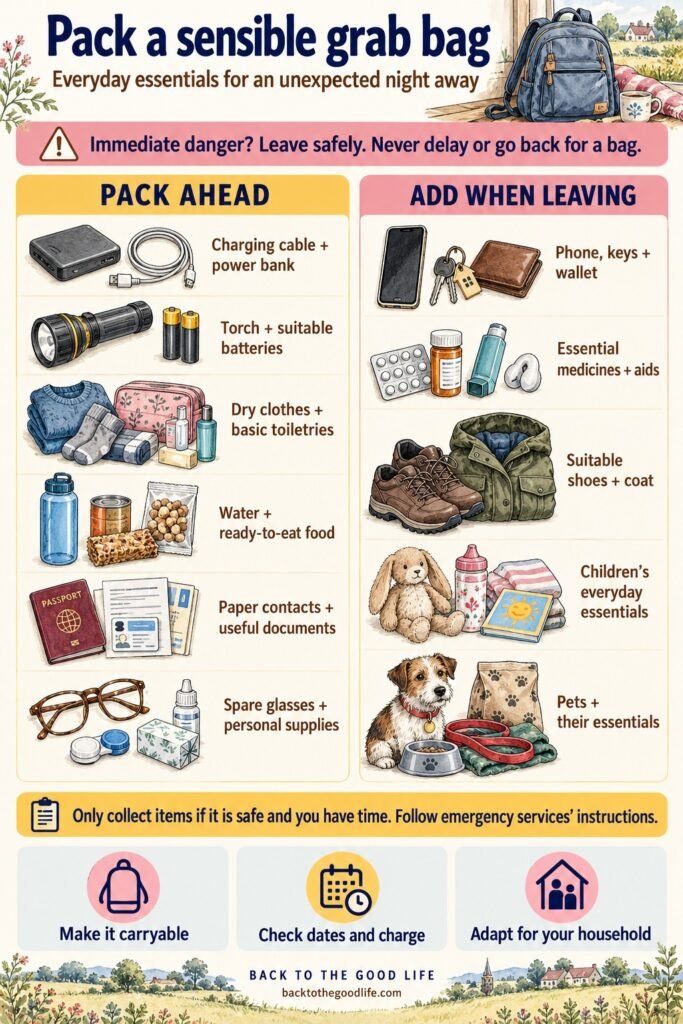
Your UK grab bag checklist: pack ahead or add when leaving
Use this as a starting point, rather than a shopping list you must complete in one go. Personal essentials take priority over optional comforts. Anything collected when leaving is conditional on having time and being able to do so safely.
| Need | Pack ahead where practical | Add when leaving, if safe |
|---|---|---|
| Health and accessibility | Spare usable glasses, relevant supplies, medication list and device instructions | Essential medicines, hearing aids, mobility or communication aids |
| Contact and charging | Tested cable, suitable wall charger, charged power bank, paper contacts | Phone and any everyday essential device |
| Light | Torch or head torch, with suitable power supply | Usually nothing extra if already checked and packed |
| Clothes and hygiene | Underwear, socks, comfortable layers, basic wash kit and period products if needed | Suitable shoes and coat |
| Food and water | Drinking water and familiar food that needs no cooking | Any daily dietary essentials that cannot stay packed |
| Information and money | Useful document copies, a pen, contacts and a little cash if affordable | Keys, wallet and essential original documents if needed |
| Children and pets | Appropriate supplies, spare clothing or bedding, a familiar comfort item | Daily feeding, care or medical items; pets in suitable restraints or carriers |
Prefer something printable? Your Sensible Grab Bag — Free Printable Checklist includes a packing checklist, space for extras, household and pet information sheets, and a detachable last-minute list.
Start with the things your household cannot easily replace
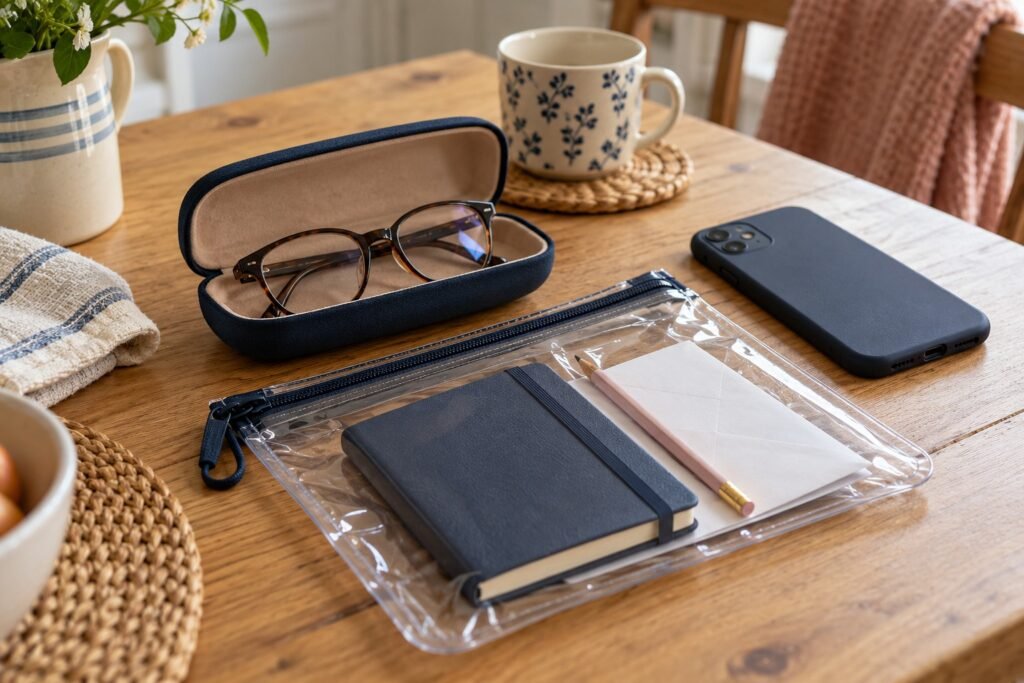
Before gathering equipment, ask everyone: “What do you rely on every day that would be difficult to manage without?” Someone else’s packing priorities may be quite different from yours.
For me, spare glasses absolutely earn their place. I normally wear contact lenses, and my prescription is minus five. A pair that gives me usable vision, protected in a hard case, is far more useful than another clever gadget.
Your priorities might include hearing-aid batteries, continence supplies, a communication aid, medical-device accessories or particular food. If equipment needs power, plan for its charging and backup requirements with the relevant care team or supplier. A phone power bank will not necessarily operate it.
For regular medicines, discuss a practical emergency supply and storage plan with your pharmacist. Keep medicines as directed, check expiry dates and record where anything that cannot stay packed is kept. A medication list is useful information, but does not replace the medicine itself.
This individual approach is reflected in West Berkshire Council’s grab-bag guidance, which includes prescribed medicines, respiratory aids, hearing aids and glasses alongside everyday essentials.
Keep your phone working and pack a separate light
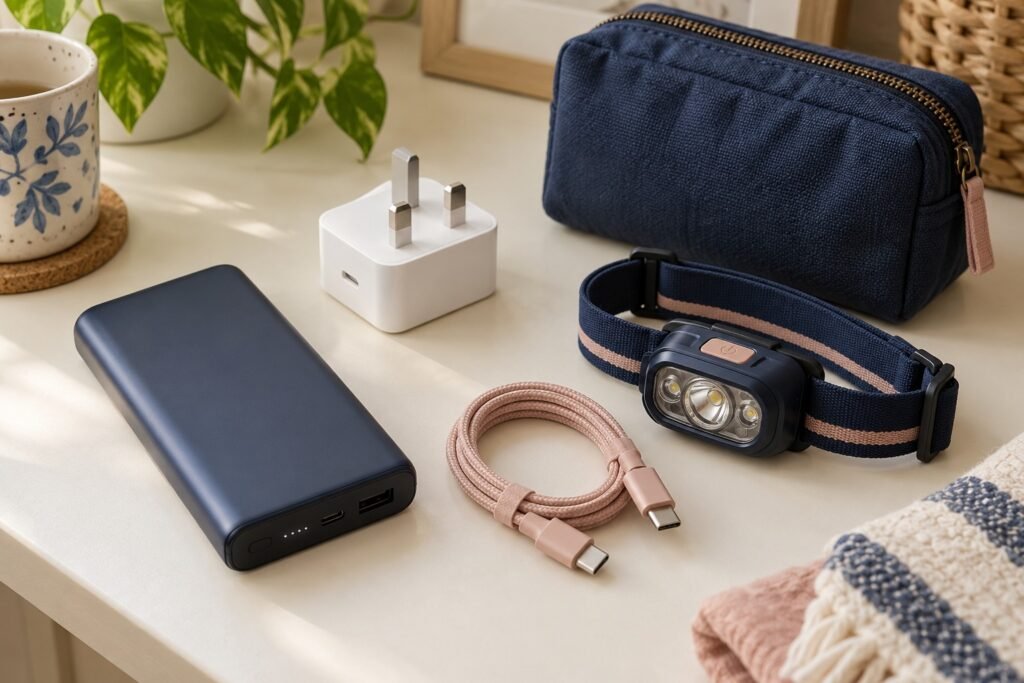
Pack a cable that fits your phone, a suitable wall charger and a charged power bank if you have one. Test the complete combination before putting it away. A cable being in the correct drawer is not quite the same as it being the correct cable.
Check that you can recharge the power bank too, and follow the manufacturer’s charging and storage instructions. The phone itself usually belongs on the last-minute list because you are still using it.
A small torch or head torch gives you light without using the phone battery. Put it somewhere easy to find, learn its controls and prevent accidental activation. If it uses replaceable batteries, pack suitable spares safely according to the manufacturer’s advice; rechargeable equipment needs a routine charge check.
A head torch can be particularly useful when you need your hands for a lead, a child or a mobility aid. Choose something you can comfortably use rather than assuming the biggest or brightest option is the best.
Pack clothes you can wear, layer and sleep in
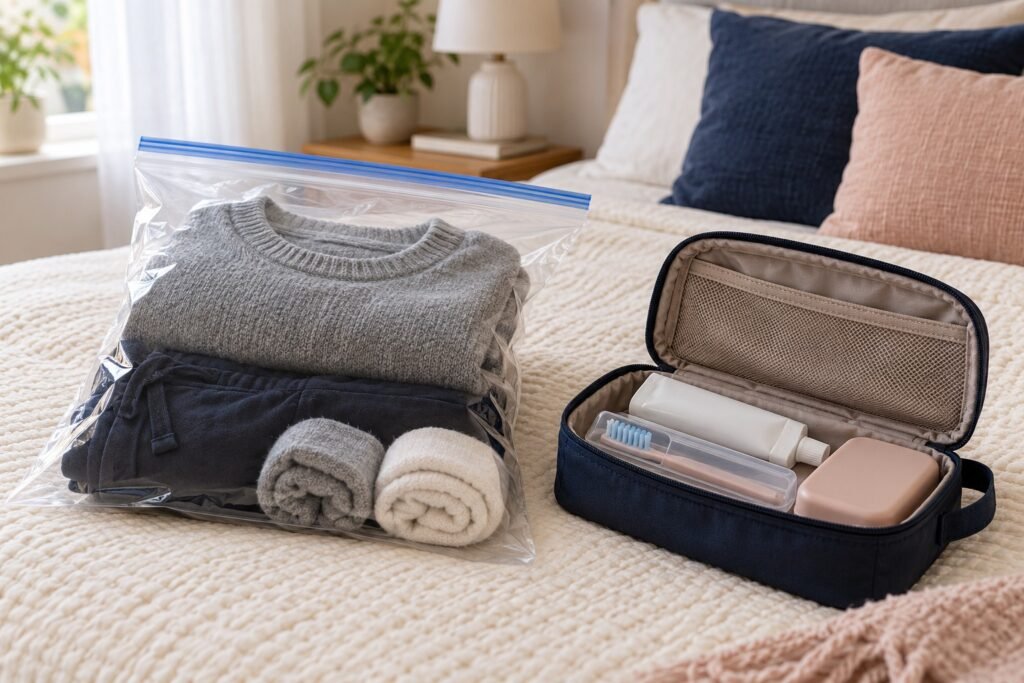
Start with clean underwear, socks and comfortable clothes suited to the season. My own choices include a lightweight jumper, a long-sleeved top and yoga trousers. They fit several jobs without needing several separate outfits.
Protect spare clothing inside a suitable dry bag or sturdy resealable bag. A simple bag can help against damp and spills, but ordinary resealable bags should not be assumed waterproof when submerged.
A compact blanket can add comfort if you have room. Treat foil emergency blankets as an extra rather than a substitute for warm clothing and safe shelter. Keep suitable shoes and a coat easy to reach as part of your everyday arrangement.
For toiletries, think about one basic wash: toothbrush, toothpaste, soap, a small flannel and any personal hygiene supplies you need. Add period products where relevant, choosing options you can manage with the washing facilities likely to be available. Keep a small first-aid kit with supplies you know how to use.
Earplugs, an eye mask and a small pack of tissues can be useful comforts. Use anything that reduces your awareness only when it is safe to rest and you can still receive important instructions.
Choose food you can eat without a kitchen
Make the core food supply something you can eat straight from its packaging. Examples include suitable cereal bars, crackers, dried fruit or ready-to-eat products labelled for eating cold. Choose around allergies, dietary requirements, age and what people will actually eat.
Check packaging as carefully as the food: can you open it, does it need a spoon, and what happens after opening? A ring-pull tin or pouch may be convenient, but check its instructions and weight before deciding.
In my video I included dried pasta-and-sauce packets as an extra in case we had access to facilities. Those are not ready-to-eat food. Some require simmering, milk or other ingredients; a hotel kettle alone may not be enough. Keep foods needing heat as optional extras only when you have a suitable way to prepare them.
A familiar treat can be comforting too, but it does not replace something more substantial. Pack enough variety that your entire food plan is not based on hoping a packet of sweets becomes dinner.
Carry drinking water and account for everyone, including pets. One litre of water weighs roughly one kilogram before the container, so test what you can manage. A couple of bottles are a starting supply, not proof that you have enough for a fixed number of people or days. Plan how you would obtain more safe drinking water once away, and follow local instructions.
Put useful information on paper
A flat or missing phone should not mean losing access to every useful number. Write down a small set of contacts, possible places to stay and any relevant medical or care information.
Include the names and details of regular medicines, relevant allergies, important service contacts and useful document copies. Keep the information current and protected from water. Copies can help you explain your situation, though they do not necessarily replace original identification where that is required.
Choose carefully what personal information to carry and store it securely. Leave passwords and bank PINs off the sheet. A small amount of cash in useful denominations may help if you can spare it; there is no required spending target for this bag.
For household planning beyond the bag, The Household Breathing Room Workbook offers more space for contacts and practical arrangements.
Make a plan for children, pets and anyone who needs help
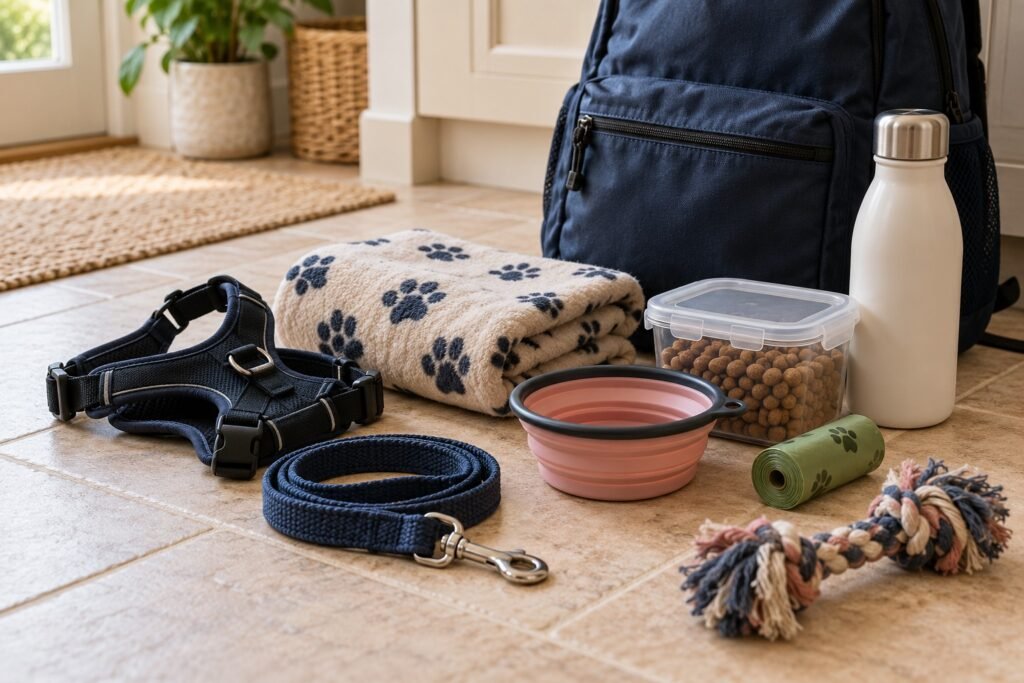
One person’s demonstration bag does not cover an entire household. G needs his own clothing and personal supplies, and Dilly needs more than a place on the passenger seat. Work through each person’s needs before deciding which items can be shared.
For children, consider appropriate feeding supplies, nappies, spare clothes and a familiar comfort item. Plan how you would manage feeding safely away from home, rather than assuming particular facilities will be available. Keep any bag a child carries light and suitable for them; adults should remain responsible for essential supplies.
For a dog, start with a suitable lead or harness, usual food, drinking water, a bowl, poo bags and any medicines. A small familiar toy or blanket may help in unfamiliar surroundings. Cats and small animals need suitable carriers and arrangements specific to their needs.
Keep a current pet photo, vet details, microchip information and relevant care records with your paperwork. The RSPCA’s flood-preparation advice includes suitable transport equipment, food supplies and protecting animal records from water.
Discuss possible places to stay before you need them. Check pet arrangements with accommodation or the people coordinating a rest centre instead of assuming every destination has the same facilities. If you need help to leave safely, plan that assistance ahead of time too. A packed bag supports a plan; it cannot carry out the plan for you.
Keep the last-minute list short and specific
Put a short list at the top of the bag for the everyday things that cannot live there permanently. Write the actual item and location, such as “phone — bedside charger” or “daily medicine — usual storage place”. Update it when your routines change.
- Phone, keys and wallet.
- Essential medicines and daily aids that are not already packed.
- Suitable shoes and coat.
- Children’s everyday care or feeding essentials.
- Pets, appropriate restraints or carriers, and their last-minute essentials.
This list is for situations where collecting items is safe and permitted. It is never an instruction to use up time you have been given or delay leaving. Decide who is helping whom, and who is carrying shared supplies, so everyone is not relying on someone else having picked them up.
Choose a bag you can actually manage
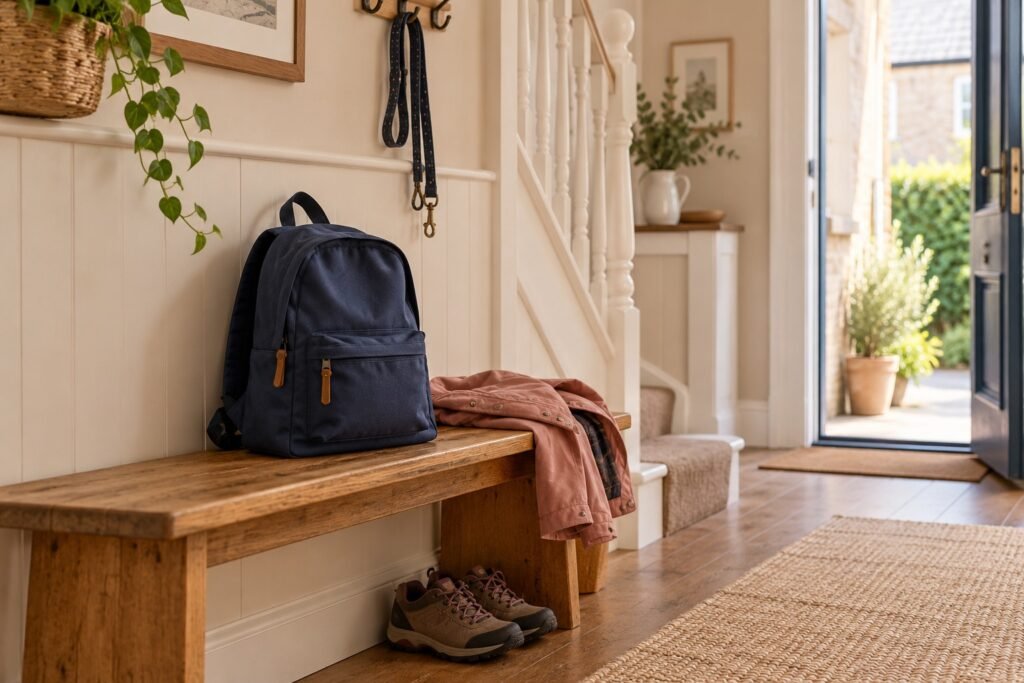
I use an ordinary inexpensive backpack because having my hands free helps when I am also handling Dilly. Use a bag that suits your body, mobility and likely journey; you do not need specialist luggage to begin.
Group things into simple pouches: charging, wash kit, clothes and paperwork. Reused suitable bags are fine. Keep the torch accessible and protect papers and dry clothing from leaking bottles.
Try carrying the packed bag around safely at home. Can you lift it, put it on and manage it while using your usual aid or holding a lead? Can you find important items without emptying everything out? If not, reduce optional extras or redistribute supplies.
Store it somewhere the household can reach easily without obstructing an exit. If flooding is a concern, take that into account when choosing the location. Everyone who may need the bag should know where it lives.
Give the bag a quick check regularly
A simple monthly reminder is a useful starting routine: test the light, check the power bank, look at food and water dates, and replace anything borrowed. Follow any shorter checks required by the equipment or supplies you use.
Review clothing seasonally and update the bag when prescriptions, contact details, children’s sizes or pet needs change. After using it, put replenishing it on your ordinary shopping list.
To make your version one today, find a bag, write the last-minute list and gather a few essentials you already own. Identify any important gap, especially medicines, accessibility or care needs, then make a realistic plan to fill it. You can improve the optional comforts over time.
Get the free Sensible Grab Bag checklist to work through your own household, or watch the full packing demonstration for a closer look at how mine fits together. You can also join the free fortnightly Wealth Pantry newsletter for more practical self-reliance alongside growing, making and preserving.
What is the personal essential someone else’s packing list would miss? That is a very good place to start yours.
Back To The Good Life is a participant in the Amazon Services LLC Associates Program, an affiliate advertising program designed to provide a means for sites to earn advertising fees by advertising and linking to Amazon.com. We also participate in other affiliate programs which compensate us for referring traffic.


One Comment
Comments are closed.